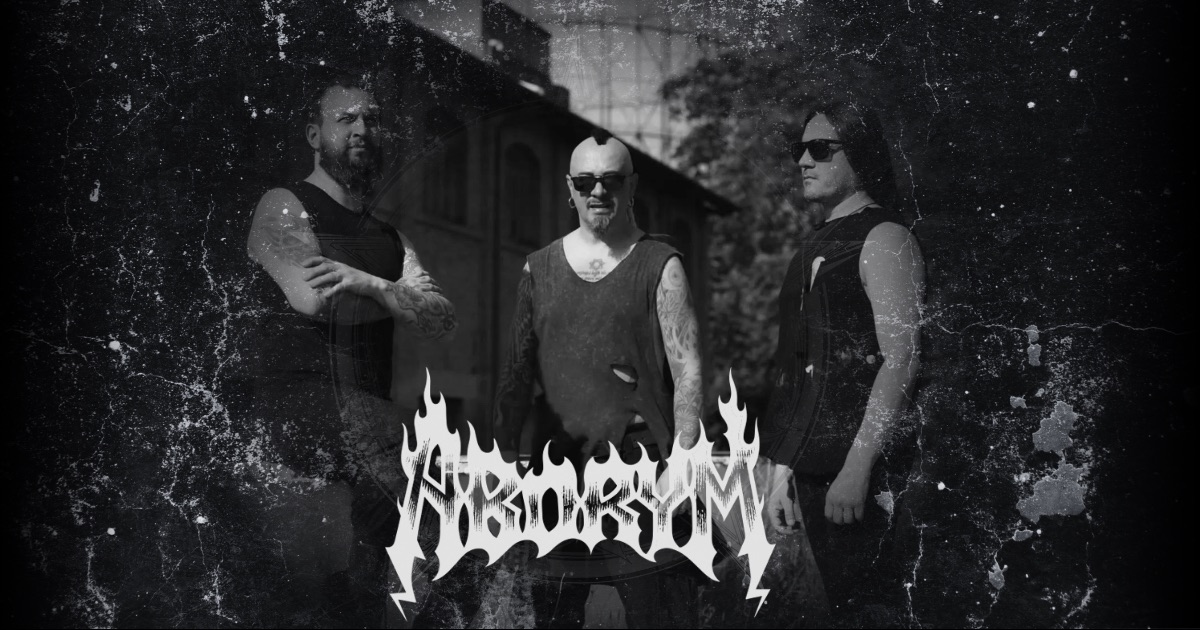
QABORYM started in Taranto in 1992, moved to Rome, and is now announcing a new album for 2026. The November announcement described it as a return to the sound of "Kali Yuga Bizarre", "Fire Walk with Us", "With No Human Intervention", and "Generator" — explicitly naming those four records. What in the music of those albums are you actually returning to, and what from the years between are you leaving behind?
A: As I answer your questions (very interesting ones), we're in the middle of mixing Metachoas, and I can only confirm the initial statements we made back in November. Considering the core of musicians behind the songwriting, I believe that what were little more than intentions in November are now certainties. There's a lot of the early albums in this new one, and I was sure we'd achieve all of this by knowing the guys in the new lineup very well. It couldn't have turned out otherwise: an extremely violent, rude album that reeks of the '90s and that is obviously 100% Aborym. Today more than ever we are able to teach the new generations how to play extreme music and how to throw out the shitty plastic music that has been produced in recent years.
QYorga S.M. was part of ABORYM from 1997 to 1999 — the period that shaped the foundation of everything that followed — and he passed away in 2024. What do you want to say about him?
A: We were never great friends, but he was the one I got the band back together with when I moved to Rome, so I considered him one of the re-founders of Aborym in those years. When he was replaced by Csihar, we lost each other over the years, only to reunite a year before his death. We cleared up some past issues and cleared the fog that had been between us, and I was very happy about that. I was very sad when I heard that Simone had died. It was a shock, especially because he had always been a hyperactive person and always physically fit. I would have preferred someone else to die.
QSet Teitan was in ABORYM from 1997 to 2005, across the three records that built the band's reputation. He later played in DISSECTION and WATAIN. What did he bring to ABORYM specifically — and what did losing that contribution do to the sound on "Generator" and after?
A: Davide Totaro hasn't been part of the band from many years and he represents a portion of the past. He decided to go abroad to seek fortune and then literally disappeared. And he wasn't the only one. So I don't really feel like talking about him, for better or for worse. I'd prefer to focus on the current state of this band.
Q"Generator" (2006) was the first ABORYM record with a real drummer — Faust — rather than programmed drums. That's not a small change for a band whose sound had been built on machines. What did a human drummer actually do to the music that the programming hadn't?
A: A good and talented drummer, like Bard was and like Atum is today, is crucial to the entire album's flow, from the songwriting stage to the final mastering. Compared to our first albums, where we used machines, today we aim for the right balance between organic drums, industrial elements, and electronics. We're definitely and naturally leaning toward a played drum setup, very '90s, and absolutely free of plasticky crap... Today, there are so many albums where drummers even trigger their own ass hair, and we don't like that. The strengths that come from the machines are directly functional to the acoustic drumming and the two things often combine with each other.
Q"Psychogrotesque" (2010) was conceived as a single continuous story — one piece of music broken into tracks. That's a structural commitment most bands wouldn't attempt. Did that constraint free the writing or make it harder, and would you do it again?
A: We usually never redo something we've already done, but in this band, there's no predictability. That album was written fluidly, following the concept and the lyrics, and it wasn't particularly difficult to put the pieces of the puzzle into place. The problems arose when we found ourselves mixing all that. I think it was the most complicated mix ever.
[VIDEO]
QBetween "Shifting.Negative" (2017) and the 2025 announcement you released "Something for Nobody" (three EPs), "The Night He Came Home", "Hostile" (2021), and "Radiophobia". That's a lot of output across a period where the band's identity was openly in flux. Looking back at that stretch now, what do you think it was actually for?
A: You know how you eat the same things for years until you feel nauseous? Well, that's what happened to me. And I felt the need to detox from extreme music, especially from much of the black metal crowd, from their extremist and radical positions and often childish and useless mentality. As much as I continue to listen to this genre (mostly old records), I think there are really a lot of assholes out there, especially here in Italy... I have nothing against music, but from my experience, unfortunately, many people have literally driven me to exasperation, and I've decided to detox from all of this.
I grew up and developed in the '90s and experienced the birth of a movement that has now transformed into a huge circus full of clowns, and I felt a strong need to distance myself and Aborym from all of this. I took this opportunity to play and experiment with less extreme music and more focused on industrial rock and electronica, and those were fantastic years. It's been a long experience that has allowed me to grow a lot technically, and now I have the opportunity to put all the expertise I've acquired over the past few years to work on the new album. I've had the honor of working with major producers like Guido Elmi and Keith Hillebrandt, I've delved into sound synthesis, I've worked as a producer for several bands, and I've grown a lot as a composer. All things I'm happy to have achieved.
Q"Shifting.Negative" was a deliberate move away from extreme metal — you said as much in interviews at the time. And now the November 2025 announcement is explicitly framed as a return. That's not a small reversal. What changed your mind — or did something change in the music itself that made the return feel necessary rather than just strategic?
A: It's much simpler than you think. During a trip to Barcelona with my wife, I spent an evening with Atum, who's lived there for years. We drank, talked, reminisced about the Malfeitor era, and reconnected as friends after so many years. Initially, we wanted to start a new musical project, and after less than a month, we had a couple of songs down... Then we brought in Malfeitor's longtime guitarist, Munholy... and within a few weeks, we realized we had four truly top-notch songs. We thought a lot about how to call this new band, but the music we had in hand sounded like Aborym... And here we are. All this happened alongside a shameful delay in finalizing an album I'd wanted to complete and release with the previous members—that is, the musicians left over from the Hostile lineup. In short, there's an Aborym electro-industrial rock album I've been working on for the past two years, but for various reasons, things fell apart, and around that time, I realized I was fed up with having to beg for a little passion from others. I completely lost my enthusiasm. Then came the trip to Spain and the meeting with Atum, who is the real mastermind behind this reunion of the "new" Aborym, who are returning to the Aborym of the '90s and 2000s.
QThe new lineup brings in Atum and Munholy, both of whom came through MALFEITOR. That's a specific shared formation being reunited inside a different band name. What does the MALFEITOR experience actually contribute to what ABORYM is going to be in 2026?
A: The entire, relatively short lifespan of Malfeitor has been the most intense and exciting period of our artistic careers and our lives for all of us. There's a chemistry between us that can't be explained. It was like that during Malfeitor's time, and it's like that today with Aborym. Together, we're capable of incredible things, and today we're rediscovering the allure of a new challenge. In the meantime, the years have passed for all of us, but we have a decade ahead of us in which we can focus our physical and mental energies on making records, concerts... and above all, spending time together having fun. On the one hand, we have our feet firmly planted on the ground, but we're also visionary dreamers and idealists, and we'll do exactly what we want to do. We call this "union."
QABORYM has released a book about its history — "Cultura del Chaos" by Mariano Fontaine, 330 pages in Italian. What does a band's story look like from the inside when someone else writes it down? Was there anything in the book that surprised you or that you'd have written differently?
A: That's a great question. Usually, when I was a teenager, I was the one who bought and read books about famous bands... Then I found myself reading a book about the history of my band, and it's something I can't explain. I didn't write the book, so I can't answer that, but I helped the author in reconstruct many years of Aborym, answering his questions and putting him in touch with some musicians from the past. Some musicians from the original lineup, like Nysrok, with whom they still have excellent relations, helped the author by releasing some statements. Others literally didn't care. It was a journey into the past, painful at times, but when I received the book, the satisfaction exceeded my expectations. Aborym Cultura del Chaos was published by Tsunami Edizioni, and Neon Black Publishing acquired the rights to an English reprint, for all our fans who don't speak Italian.
QWe stock the physical records because the music earns its place — not for nostalgia or genre completism. "Dirty", "Generator", "Psychogrotesque", and "Shifting.Negative" are four very different records from the same band across fifteen years. Which one do you think holds up best now, and why?
A: First of all, thank you. Of the ones you mentioned, I think "Generator" is the most "charged" artistically, but also and above all emotionally: it was Aborym's first album with a drummer, the last with Nysrok on guitar, and in some ways it closed a sort of cycle to open others. I'm obviously very attached to every Aborym album, but I think "Generator" is unique in its own way.