## ⛤ THE PLACE ⛤
Ukraine's metal underground was never a one-city story. It spread across a country that, through the 1990s and 2000s, was cut off enough from Western Europe that every scene had to build its own infrastructure from the ground up. Kharkiv drew international attention as the black metal capital, but death metal took root in places rarely mentioned. Uzhhorod, right on the Slovak and Hungarian borders, built one of the country's strongest regional death metal scenes. Kyiv produced some of the earliest bands. Donetsk and the eastern cities leaned hard into brutal death metal. Lviv, Zaporizhzhia — every major city had something happening, often without any idea what was going on two hundred kilometers away. Geography shaped the sound. Western bands like [CASTRUM](https://www.facebook.com/castrum) played melodic, technical death metal with a clear European lineage. Eastern bands like [DATURA](https://www.facebook.com/daturaofficialpage) pushed toward brutal death, becoming heavier and more American in influence. Kyiv sat in between. There was never a single Ukrainian death metal sound—there were several, each developing in its own pocket of isolation.
## ⛤ THE NETWORK ⛤
People, not infrastructure, held the scene together. Ukraine never had the kind of label system for death metal that Scandinavia or the US did. Moon Records in Kyiv came closest to a national distributor, but it started as a pirate cassette operation in the 1990s and only went legit later. In Uzhhorod, [Trismus Records](https://trismusrecords.bandcamp.com/) — a small DIY label — put out records from local bands like [SOULREST](https://www.facebook.com/Soulrestofficial/) and [ОБРІЙ](https://www.facebook.com/obriymetaluzh). Most of what happened ran on self-released demos, tape trading, and the kind of personal connections that come from sharing rehearsal spaces and stages.
The real glue was the people. Musicians moved between projects constantly. The same names surface across bands, cities, and decades. [CASTRUM](https://www.facebook.com/castrum)'s drummer Eugene Ryabchenko ended up in [belphegor](http://www.belphegor.at/) in Austria. Members of [SOULREST](https://www.facebook.com/Soulrestofficial/) fed into [ОБРІЙ](https://www.facebook.com/obriymetaluzh), THE SYMBIOZ, [SKRUTA](https://www.facebook.com/skrutagrindcore), and DISPLEASE — all from the same small western city. In Kharkiv, the black metal and death metal circles overlapped completely. The musicians who built the black metal scene didn't stop there; they kept working, and when [NECROM](https://www.facebook.com/necromofficial/) formed in 2018, it brought together veterans from across the Kharkiv underground into a project focused entirely on old-school death metal. That lineup is a map of everything Kharkiv built over two decades.
Festivals mattered. In Uzhhorod, Cornelius from [CASTRUM](https://www.facebook.com/castrum) started the Death Metal Assault concert series, which grew into UzhGoreRot — a Ukrainian answer to Obscene Extreme. In Kharkiv, Metal East: Nove Kolo became the biggest stage for Ukrainian extreme metal, bringing together international acts and domestic bands and finally giving death metal the visibility it had always lacked. Both are gone now. UzhGoreRot ran its course. Metal East happened once, in 2019, and then everything changed.
## ⛤ THE MUSIC ⛤
Ukrainian death metal never settled on a single signature sound, and that's part of what makes it worth following. Brutal death metal dominates by numbers — bands like [FLESHGORE](https://fleshgore.bandcamp.com/) from Kyiv, [MENTAL DEMISE](https://www.facebook.com/pg/Mental-Demise-1431129803598839), [DATURA](https://www.facebook.com/daturaofficialpage) from Donetsk, [AMBIVALENCE](http://ambivalence.bandcamp.com/) from Lviv, [ENDOCRANIAL](https://endocranialkiev.bandcamp.com/) from Kyiv — all working in that territory, each with their own approach. [FLESHGORE](https://fleshgore.bandcamp.com/) managed to break out internationally, playing Wacken, Brutal Assault, and Obscene Extreme — one of the few Ukrainian death metal bands to make that leap.
The edges are where the scene gets most compelling. [CASTRUM](https://www.facebook.com/castrum) in Uzhhorod played technical, melodic death metal with a medieval lyrical focus — closer to the European tradition than anything else happening in Ukraine at the time. DEFLECTED SENSE from Horlivka lasted only four years but left one album, "Commentaries at the Edge of the Abyss" on Moon Records in 1999, that sounded more like MESHUGGAH than anything else in the Ukrainian scene: progressive, cold, structurally complex. PHANTASMAGORY from Donetsk pushed into avant-garde progressive metal territory with no real precedent in the country. [INFECTED](https://infectedband.bandcamp.com/) from Kyiv were among the first, active from 1991, releasing a split with Japan's [UNHOLY GRAVE](https://www.facebook.com/profile.php?id=100050618613543#) before disappearing in 1998 and resurfacing over a decade later.
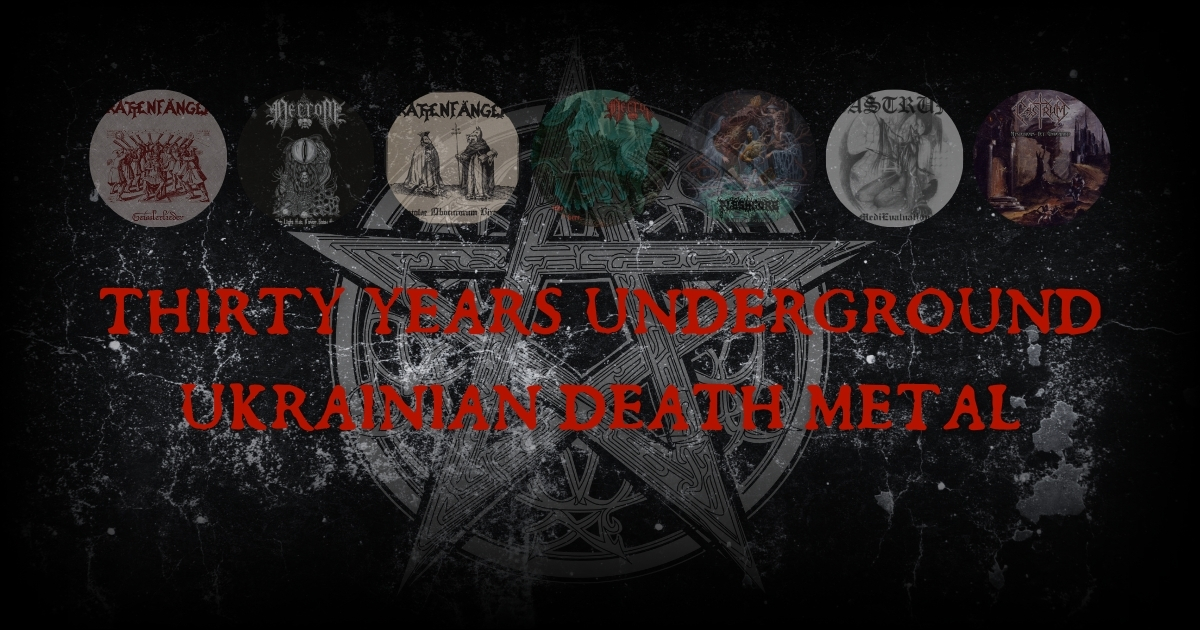
[NECROM](https://www.facebook.com/necromofficial/) formed in 2018 by veterans of the Kharkiv scene, playing old-school death metal stripped to the essentials. Swedish-influenced, direct, ascetic. Now signed to Osmose Productions and releasing records that stand with the best European OSDM. [RATTENFÄNGER](https://rattenfanger.bandcamp.com/) comes from the same Kharkiv circle — all four members also play in [DRUDKH](https://www.facebook.com/Drudkh.Official) — playing death/doom with Latin lyrics written in the style of medieval poetry. Two albums in and still sounding like nothing else in the Ukrainian underground.
[1914](https://x1914x.bandcamp.com/music) from Lviv brought blackened death/doom built entirely around World War I to Napalm Records and the international stage. They perform dressed as Austro-Hungarian soldiers — Galicia, where Lviv sits, was under Habsburg rule in [1914](https://x1914x.bandcamp.com/music). The commitment to the theme is absolute, and the music delivers on it.
## ⛤ THE DEEP ELEMENT ⛤
The war changed everything and nothing.
Since 2022, Ukrainian metal musicians have been mobilized, displaced, and split across borders. [DATURA](https://www.facebook.com/daturaofficialpage), the long-running brutal death metal band from Donetsk, split in two: one version based in Ukrainian-controlled territory, renamed ETSYKH, and another continuing as DATURA from the other side. [1914](https://x1914x.bandcamp.com/music) had to cancel their 2023 tour because members couldn't get permission to leave — men aged 23 to 60 needed authorization that was hard to secure. They only managed to tour again in 2026, starting in Poland, six years after their last proper run. The Metal East: Nove Kolo festival in Kharkiv — the one event that gave the Ukrainian extreme metal scene an international platform — is gone. Kharkiv itself has been under constant bombardment.
But the scene kept moving. If anything, the underground got tighter. The musicians who stayed kept recording. The labels that survived kept releasing. The compilation "Nation of the Unconquered" brought together unreleased tracks from Ukrainian metal bands — [LUTOMYSL](https://lutomysl.bandcamp.com/music) included — to support the country's resistance. The identity that was always in the music — the Slavic melodies, the Ukrainian-language lyrics, the conscious separation from Russian cultural influence — became more visible and more deliberate. What was already present before 2022 became impossible to miss after.
Ukrainian death metal was never the country's main metal export. It always lived in the shadow of black metal. But the people who built it are the same — the same stubbornness, the same isolation turned into creative identity, the same refusal to wait for outside validation. The difference is that death metal in Ukraine never built a mythology around itself. No mystique, no folklore, no Pitchfork features. Just records, made by people who kept showing up.
## ⛤ THE CONNECTION ⛤
I found this scene through the records, not through articles or recommendations. Since 2023, every Ukrainian death metal record that has come through Pulse Records has earned its place — the quality has been consistently high, enough to keep me digging for more. The underground still carries traces of its Russian-language past, but the foundation and identity are unmistakably Ukrainian, and that has only become clearer in recent years. From Lisbon, my job is to stock the records, write about them, and make sure the people who care know where to find them. The scene exists. The records do the talking.